Preface
When THE OERA LINDA BOOK first came to light, around the middle of the nineteenth century, it was attacked forthwith from all quarters and denounced as a fraud. These detractors among the scholarly and journalistic establishment feared the implication of this history, namely that the Teutonic or Northern nations did not consist of quaint, backward savages who so remained until their contact with the so-called high civilizations of the South and East, but rather an enlightened, seafaring people whose ethical philosophy and metaphysics show an advanced level of thinking, who were, moreover, the basis of much classical mythology.
In the year 1848, Cornelius over de Linden, master ship-wright at the Royal Netherlands Dockyards at Helder, near the West Frisian island of Texel came, through his Aunt Aafjie Meylhof, into possession of a text or collection of several writings which had been in the care of his departed grandfather, Andries over ae Linden. The works were written in an unusual script and Cornelius may have studied runes in hopes of understanding it.
Not being himself a scholar and thus unaware of the possible import of his possession, he waited nineteen years to present it to a Dr. Elco Verwijs, Archivist of the Province Friesland, who, seeing that it was written in an ancient Frisian, asked the Frisian Society, FRIESCH GENOOTSCHAP for support in the translation and pub- lication of the writings; this was not granted.
Finally, the cause of THE OERA LINDA BOOK was taken up by a Dr. J. G. Ottema who edited, translated the works into Netherlands and published them in two editions, one in 1872 and another in 1876 which is used in this English translation.
One factor which weighs heavily in favour of the text’s authenticity is that the knowledge that the West Frisian Islands were once part of the mainland is only 80 to 90 years old; Cornelius over de Linden, therefore, could not have had access to this information when he first brought the writings to public attention.
Moreover, investigation into the amount of Cl 4 in the growth rings of the ancient bristlecone pine has revealed that the decrease in the amount of the radioactive carbon is not constant as once thought, for some very old tree rings show more Cl 4 than one had expected of them. This has caused a revolution in thinking about early history. The so-called megalithic tombs of Northern and Western Europe can no longer be understood as imitations of Mediterranean or Near Eastern designs such as those of Mycenae or Egypt simply because they are older. Further more, it has been demonstrated that there was considerable use of metalurgy on the Danube by at least 4000 B.C. In other words, the North-West rather than the South-East was the cradle of civilization, if indeed there were such a thing. If, after reading THE OERA LINDA BOOK, one examines the concentrations of ancient monuments and tombs in Europe, one shall find that they occur in those lands which are mentioned as once belonging to Frya, and, indeed, in modern Friesland as well.
One must also notice the abrupt gaps, in the continuity, of these most ancient finds, in eastern Britain and in the Low Countries. It seems highly unlikely that people mysteriously chose not to build any tombs or monuments in those areas. It is rather more likely that there were once tombs and monuments there but that one of the natural disasters mentioned in THE OERA LINDA BOOK, such as the sinking of Aldland, overwhelmed the structures in floods, for these sudden absences of tombs and monuments are noticeable mainly in coastal lowlands near or on the southern North Sea. It is clear that there was some connection between the builders of Stonehenge and the Ring of Brogar in the Orkney Islands and the people upon whom THE OERA LINDA BOOK is based. Their age bears witness to the truth of this book, but they have yet had little else tell.
From the time of Martin Luther, it has been the intention of translators not to produce the greatest possible likeness of the original text, but rather to create new literature based on the original work.
While this may allow the translator to write better, more readable prose, it keeps one from a truer understanding of the work at hand. One has indeed little more than secondary literature.
This is a great fault of the other translation, of THE OERA LINDA BOOK, by William R. Sandbach, published in 1876. In an attempt to render the text in good, standard-modern English, Mr. Sandbach has diluted and well has lost the character of these writings, and therewith some of their meaning. furthermore, there are a number of mistakes in the Sandbach rendering which I, though not undertaking a critique of his work, have noticed. The following is a list of some of these mistakes:
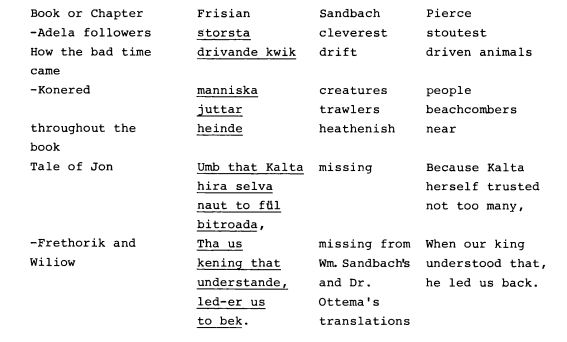
The text speaks of Frisians or FRYAS in both a broad and a narrow sense. At first, it is a general name for all those Northern European stock or Frya’s children, who were confederated under the authority of the Folksmother at Texland. But then, as they became false to the teaching of Frya and thus to the ideas of their own race, the definition of FRYAS shrank until it applied only to those regions which are yet known as Frisian.
When the Frisians themselves became corrupt, their name became only a vestige. So as not to impose my own sense upon the writings, and thereby risk making the collection a thing of my own creation, I have not tampered with Dr. Ottema’s punctuation and capitalization save to keep the text from complete obscurity.
The reader might note, for example, that I capitalize “earth” only when speaking of the Earth Mother.
The grammar might well offend the modern sensibilities with its run-on sentences and compound negatives. Such irregularities are attributed to the fact that, in 1256, when Hiddo oera Linda produced the last translation of his books, at least the Northern European languages were in a state of flux. There was, during the time of Hiddo oera Linda, a confluence of dialects and even language; there were no hard, fast standards of grammar and spelling to distinguish proper from improper usage.
This resulted in the quickness of linguistic evolution which was experienced in those days. This is further complicated by the wont of scribes, of that period, to modify older texts so that they might be better understood by the public; hence, mixed texts, those which contain elements of more than one period. Therefore is the relative modernity of many of the references made in this book no cause to doubt the antiquity of its sources.